
AI Search for E-Commerce: How It Improves Product Discovery
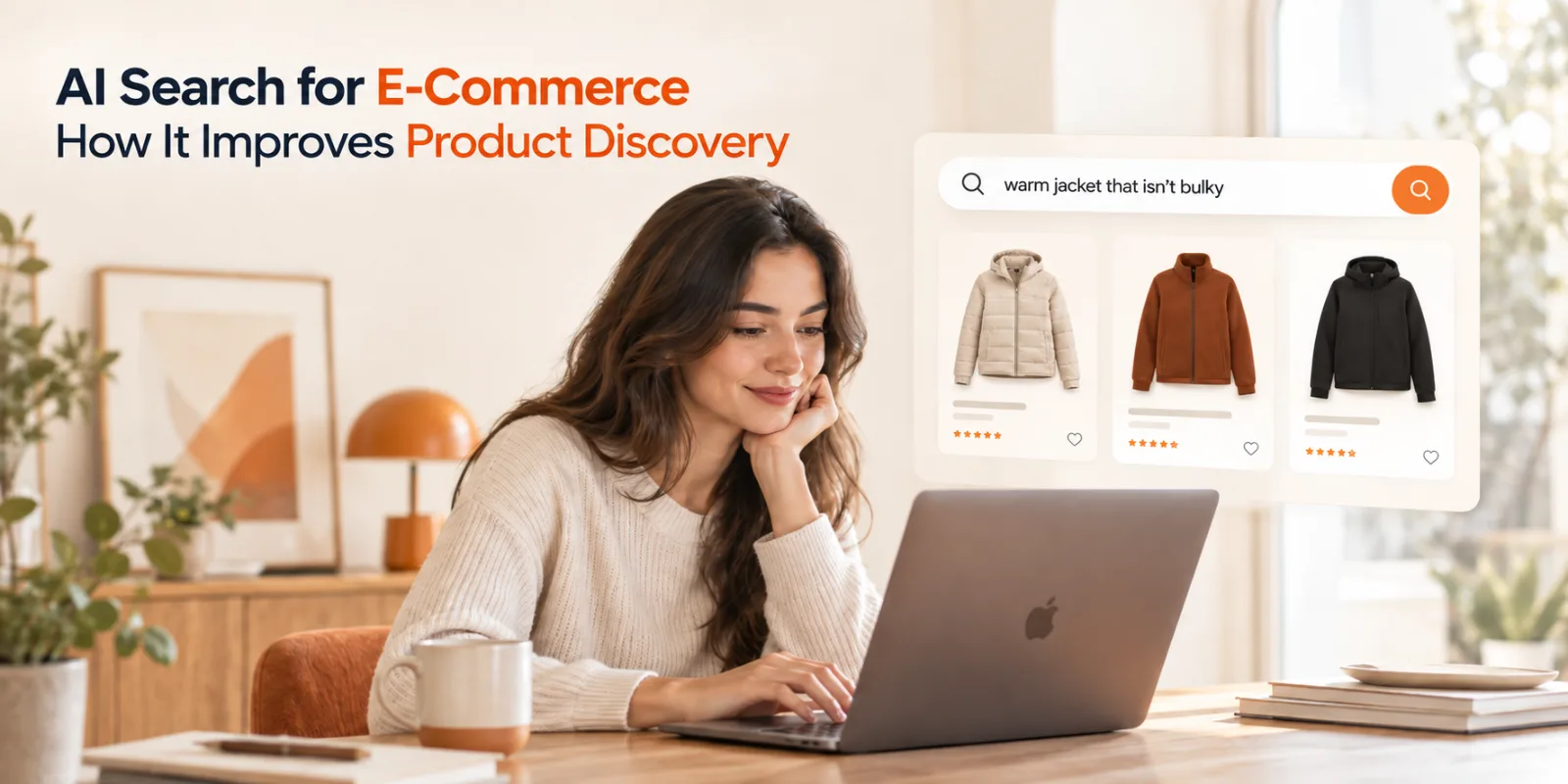
AI search for e-commerce improves product discovery by understanding shopper intent rather than relying only on exact keyword matches. It can interpret natural-language queries, product attributes, context, and behavior to surface more relevant products faster.
For many e-commerce brands, the challenge is not a lack of inventory. It is helping shoppers find the products that best match what they are actually looking for. Traditional keyword-based search can struggle when customer language differs from the terminology used in a product catalog.
AI search helps close that gap by connecting intent with relevant products more effectively. When discovery improves, shoppers can move from search to product evaluation with less friction.
The real value of AI search is not simply smarter technology. It is making more of the demand already reaching your store discoverable and actionable.
Key Takeaways:
AI search understands intent, not just keywords. It can interpret what shoppers mean even when their wording does not exactly match product titles or descriptions
Natural-language and semantic search improve discovery for conversational, descriptive, and imperfect queries
Better search can reduce discovery dead ends such as zero-result searches or irrelevant product listings
Search analytics reveal customer demand by showing what shoppers search for, where they struggle, and which queries lead to engagement
AI search should be measured as a CRO channel, using metrics such as search-to-product clicks, add-to-cart behavior, conversion rate, and search-attributed revenue
What Is AI Search for E-Commerce?
AI search for e-commerce is a search system that can use natural-language understanding, semantic matching, machine learning, and behavioral signals to better interpret what shoppers are looking for and rank relevant products accordingly.
Unlike traditional search, which often depends on exact keywords and predefined synonyms, AI-powered systems can evaluate semantic relationships, product attributes, query context, and other relevance signals.
Traditional Ecommerce Search | AI E-commerce Search |
Relies heavily on keyword matching | Interprets meaning and intent |
Struggles with conversational queries | Handles natural-language searches |
Depends heavily on predefined synonyms | Identifies semantic relationships |
Often returns generic rankings | Can use contextual and shopper signals |
Search data mainly reports queries | Analytics can reveal intent and conversion behavior |
That does not mean keyword search is obsolete. For many stores, the stronger approach is hybrid search, combining lexical matching for precision with semantic understanding for broader intent recognition. This helps e-commerce teams improve relevance without losing the control and accuracy traditional search can still provide.
How AI Search Improves E-Commerce Product Discovery
The difference becomes clearer when shoppers move beyond simple product-name searches. Real e-commerce queries can combine preferences, exclusions, attributes, budgets, and use cases within a single request.
AI search can help e-commerce stores handle that complexity in several ways.
1. Understand Natural-Language Intent
AI search can process conversational queries such as
“linen shirt but not white”
“gift for a runner under $50”
“warm jacket that isn't bulky”
These searches may contain several layers of intent, including
a product category
a preference
an exclusion
a price limit
an intended use
Instead of requiring shoppers to translate that intent into several filters and keyword variations, AI search can interpret more of the request from the original query.
This creates a shorter path between what the shopper has in mind and the products they actually see.
2. Matches Meaning, Not Just Keywords
The language customers use does not always match the language used in a product catalog.
For example:
A shopper searches for “rain jacket”
The catalog uses “water-resistant shell”
The products are relevant, even though the wording is different
Semantic search can identify these relationships by looking at meaning rather than exact phrasing.
This helps e-commerce stores:
Connect customer language with catalog terminology
Surface relevant products for alternative phrasing
Reduce dependence on manually created synonym lists
Make more of the existing catalog discoverable
For larger catalogs, this can prevent useful products from becoming difficult to find simply because shoppers describe them differently.
3. Handles Attributes and Context Together
Product searches frequently contain several requirements at once.
A shopper may specify:
Product type
Size
Material
Price range
Color
Exclusions
Intended use
For example, “black waterproof hiking shoes under $120” combines:
Product category: hiking shoes
Color: black
Feature: waterproof
Use case: hiking
Budget: under $120
The challenge is not recognizing each term individually. It is understanding that all of those requirements belong to the same search intent.
AI search can support this type of multi-constraint discovery, helping shoppers narrow a large catalog through the query itself rather than relying entirely on filters and category navigation.
4. Improves Which Products Appear First
Finding potentially relevant products is only part of the search experience. Their order matters too.
AI-powered ranking can consider signals such as
Query relevance
Product attributes
Catalog information
Search context
Shopper behavior
Previous interactions
This can help place stronger matches closer to the top of the results.
That distinction is important because:
Retrieval determines which products qualify.
Ranking determines which of those products receive visibility.
If a store returns 100 relevant products but the strongest matches are buried several pages deep, product discovery is still weak.
Good AI search therefore focuses not only on finding relevant inventory but also on presenting the most useful products where shoppers are most likely to see them.
5. Reduces Search Dead Ends
Poor site search often leads to:
Zero-result pages
Irrelevant product results
Repeated query reformulation
Unnecessary exits from the search experience
AI search can reduce these dead ends by using capabilities such as
Typo handling
Synonym recognition
Semantic matching
Broader intent understanding
Contextual interpretation
For example, a small misspelling or unfamiliar phrase does not necessarily have to produce an empty results page if the system can still identify what the shopper is trying to find.
The goal is not to return something for every possible search. It is to make sure relevant products are not unnecessarily hidden because the shopper used different wording, added several requirements, or made a typing mistake.
For e-commerce businesses, this makes product discovery less dependent on shoppers understanding how the catalog is structured—and more responsive to how people naturally search.
Why Traditional Site Search Can Limit Product Discovery
Traditional site search can limit product discovery when it depends too heavily on exact keyword matches. Shoppers rarely know or use the same terminology as an e-commerce catalog, especially when their searches include several requirements.
A customer may search for:
specific product attributes
colors or materials
price limits
exclusions
intended use cases
multiple preferences in one query
For example:
Shopper searches: “Lightweight black jacket for rainy weather”
Catalog terminology: “Water-resistant packable shell”
Both describe a potentially relevant product, but a keyword-heavy search system may struggle to connect them because the wording does not closely match.
As a result, products that match a shopper’s requirements can remain effectively hidden because the search system cannot bridge the gap between customer language and catalog terminology. The problem becomes even more noticeable as product assortments grow and search queries become more conversational.
From a business perspective, this creates an important discovery gap: a product that exists in inventory but cannot be discovered for relevant shopper intent is commercially similar to a product the shopper never saw.
That is why improving site search is not only a search-relevance issue. It is also a product discovery and conversion opportunity.
From Search Query to Conversion: Why Discovery is a CRO Issue
Site search is often treated as a navigation feature, but for many e-commerce stores, it is part of the conversion funnel.
A typical search journey looks like this:
Shopper Intent → Search Query → Product Results → PDP → Add to Cart → Checkout
Every step depends on the previous one working well. If the search experience fails to connect a shopper with relevant products, the journey can break before the customer even reaches a product page.
Research into e-commerce search UX has consistently found that weak search support can make shoppers assume relevant products are unavailable, even when those products exist in the catalog.
That can lead to:
Fewer search sessions progressing to PDPs
Relevant inventory receiving less visibility
Fewer add-to-cart opportunities
Repeated query reformulation
Higher chances of shoppers exiting the site
This is why site search should be evaluated by what happens after the query, not only by the quality of the results page.
Improving search relevance does not guarantee a conversion. Pricing, product quality, PDP content, trust, shipping, and checkout still matter. Better search cannot guarantee a sale, but it can increase the likelihood that qualified shoppers progress from a query to a product page, cart, and eventually checkout.
For founders and ecommerce teams, that makes search optimization part of a broader conversion strategy rather than a standalone UX improvement.
How Growmerce Helps
AI search becomes more commercially useful when e-commerce teams can connect search behavior with measurable downstream outcomes. Growmerce approaches this through Growsearch, which is designed to understand natural-language queries, shopper intent, product attributes, synonyms, and context rather than relying only on exact keyword matches.
This can support CRO in several ways:
Understand intent beyond keywords: Queries such as “linen shirt but not white” can be interpreted as a combination of product type, material, and exclusion rather than treated as separate words
Improve product relevance: Meaning-based matching and personalized ranking can help stronger product matches appear more prominently, making discovery more useful for each shopper
Connect search with conversion behavior: Growmerce tracks metrics including search-attributed revenue, add-to-cart rate, click-through rate, zero-result rate, and query-to-purchase journeys
Identify discovery gaps: Zero-result terms and shopper queries can reveal where search relevance, merchandising, or even catalog coverage may require attention
This moves e-commerce teams beyond simply knowing that “people are searching for X.” They can begin asking whether those searches lead shoppers to relevant products, add-to-cart actions, and eventual checkouts.
That turns site search from a basic utility into a measurable part of the CRO strategy.
What to Look for When Choosing AI Search for Ecommerce
The best AI search for e-commerce is not necessarily the platform with the longest feature list. The right solution depends on your catalog size, customer behavior, merchandising requirements, technical setup, and the search problems you are trying to solve.
When comparing options, look for capabilities such as
Natural-language understanding
Semantic and keyword-based retrieval
Product attribute and filter awareness
Relevant product ranking
Fast response times
Personalization capabilities
Merchandising controls
Ecommerce platform integration
Search and query analytics
Conversion attribution
It is also worth checking how much control your team has over ranking rules, promotions, product visibility, and reporting. AI should improve discovery without making search performance harder to understand or manage.
Most importantly, do not evaluate an AI search engine for e-commerce only through polished demo queries. Test it using the messy, commercially important searches real shoppers already make on your store.
Those searches are more likely to reveal whether the system can handle your actual catalog, customer language, and conversion opportunities.
Better Ecommerce Search Starts With Better Intent Understanding
Better e-commerce search starts with understanding how shoppers actually express what they want. AI can help connect natural-language queries, product attributes, and customer intent with relevant products in the catalog.
For e-commerce teams, that can mean:
Helping shoppers discover relevant products faster
Creating a clearer path from search results to product evaluation
Reducing friction caused by weak or irrelevant search results
Using search analytics to identify CRO opportunities
Measuring how search behavior connects with add-to-cart and conversion activity
For teams evaluating AI search, the key question is not simply whether the technology understands complex queries. It is whether that understanding helps shoppers find the right products—and whether the business can measure what happens next.
FAQs
1. What is the difference between AI search and traditional e-commerce search?
Traditional search often depends heavily on keywords and predefined synonyms. AI search can interpret natural language, semantic relationships, product attributes, and contextual signals to improve relevance.
2. What should I look for in the best AI search for e-commerce?
Look for natural-language understanding, hybrid retrieval, strong ranking, personalization, merchandising controls, e-commerce integrations, search analytics, fast performance, and conversion attribution.
3. Can AI search help improve e-commerce conversion rates?
AI search can support CRO by helping shoppers reach relevant products more efficiently. It does not guarantee conversions, but it can reduce discovery friction and create more opportunities for product evaluation and add-to-cart actions.
4. What metrics should e-commerce brands track for site search?
Useful metrics include zero-result rate, search exit rate, search-to-PDP click-through rate, add-to-cart rate, search conversion rate, query performance, and search-attributed revenue.
5. What are AI search analytics tools used for in e-commerce?
AI search analytics tools help teams understand what shoppers search for, where discovery breaks down, which queries lead to engagement, and how search behavior connects with conversion outcomes.